
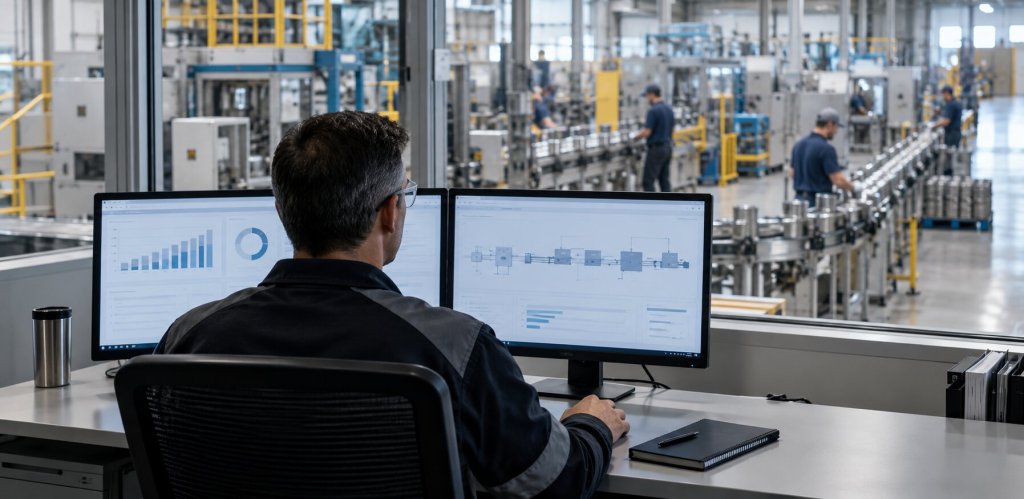
During my early manufacturing years, automation was becoming increasingly visible on the shop floor.
Machines had sensors and limit switches. PLCs controlled operating sequences. SCADA screens displayed process conditions. Alarms warned teams when something moved outside the expected range.
For that period, seeing a production process through a screen felt like a significant advance.
But the shop floor taught me an important lesson:
Seeing a problem is not the same as controlling it.
A display could show that a parameter had crossed its limit. An alarm could attract attention. A report could record when the deviation occurred.
But none of these could replace the decisions and actions required to bring the process back under control.
Someone still needed to understand the signal, determine its importance, take corrective action, and verify that the process had stabilized.
That distinction remains highly relevant in today’s digital enterprise.
Visibility is only the first step
A genuine control system requires more than information.
It requires a connected sequence:
Signal → Interpretation → Decision → Action → Feedback
If any part of that sequence is missing, visibility may improve without improving the outcome.
An alarm without a responsible owner may remain unattended.
A trend without an agreed threshold may invite different interpretations.
A recommendation without decision authority may wait for repeated discussions.
An action without feedback may correct the immediate symptom while leaving the underlying cause untouched.
This was true on the manufacturing floor, and it is equally true in enterprise systems.
The modern enterprise has many dashboards
Organizations today have more visibility than ever.
SAP systems, analytics platforms, supply-chain control towers, workflow tools, and executive dashboards can display large volumes of operational information.
Leaders can see inventory positions, supplier delays, forecast changes, production constraints, customer-service risks, financial exceptions, and project performance.
The presentation may be sophisticated. Measures may be updated frequently. Risks may be highlighted in red, amber, and green.
Yet an important question remains:
What happens after the dashboard identifies a problem?
If the answer is another spreadsheet, another email chain, or another meeting to determine ownership, the organization has visibility—but not control.
A supply-chain example
Consider a dashboard showing that demand for an important product has increased sharply.
The dashboard may display current inventory, open purchase orders, production capacity, customer priorities, and the projected date of a shortage.
That is valuable information.
But the dashboard alone cannot resolve the risk.
The organization must know:
- What level of demand change requires intervention?
- Who owns the response?
- Can inventory be reallocated between locations?
- Who can authorize expedited supply or additional production?
- Which customers or channels receive priority?
- How will finance, sales, operations, and procurement align on the decision?
- How will the actual result be compared with the recommendation?
Without these rules and responsibilities, the control tower becomes an observation tower.
Everyone can see the problem. No one is certain who should act.
What SAP transformation must deliver
An SAP transformation should certainly create greater process visibility. Integrated transactions and shared data can provide a more consistent view across business functions.
But visibility should not be treated as the final outcome.
The stronger objective is to create a more responsive operating model.
That requires the transformation to connect information with:
- Defined process ownership
- Agreed decision thresholds
- Clear approval authority
- Executable workflows
- Exception-management procedures
- Measurable business outcomes
- Feedback for continuous improvement
These elements should be designed into the business process—not left for users to establish informally after go-live.
Otherwise, the organization may replace disconnected legacy reports with modern dashboards while preserving the same delays in decision-making.
Technology cannot resolve unclear accountability
Many operational problems are described as data or system issues when the real weakness is unclear accountability.
A report may correctly identify overdue orders. A planning system may correctly highlight a shortage. A workflow may correctly escalate an exception.
But if several functions share involvement and no one owns the end-to-end outcome, the problem may continue moving between teams.
The question is not only, “Is the information accurate?”
It is also:
Who is expected to do what because of this information?
That is where technology design and operating-model design must come together.
A well-designed system makes the condition visible. A well-designed organization makes the response clear.
Business AI makes the distinction even more important
Business AI can move enterprises beyond traditional dashboards.
It can detect patterns, explain exceptions, predict risks, recommend responses, and increasingly initiate actions across workflows.
This creates enormous potential—but it does not remove the need for operating discipline.
An AI recommendation still requires business context. The organization must define objectives, constraints, decision rights, approval limits, and accountability.
For example, an AI agent may recommend moving inventory to protect customer service. But the business must determine whether that action is permitted, which customers receive priority, what cost is acceptable, and when human approval is required.
AI can strengthen the chain from signal to action.
It cannot responsibly replace the chain with an undefined promise of automation.
The more capable the technology becomes, the more important it is to establish who remains accountable for the outcome.
From monitoring to management
A useful test for any dashboard, control tower, or AI-enabled solution is to ask five questions:
- What condition are we trying to control?
- What signal tells us that intervention is required?
- Who has responsibility and authority to act?
- What action should follow?
- How will we know whether the action worked?
If these questions cannot be answered, the organization may have implemented reporting rather than control.
The shop floor made this distinction easy to understand. When a production parameter moved outside its permitted range, displaying the deviation was useful—but restoring and maintaining the process was what protected the operation.
The same principle applies to enterprise transformation.
A dashboard tells us what is happening.
A control system connects that information to a disciplined response.
Digital transformation creates value not when the organization can see more, but when it can decide and act better.
 Raju Saripudi
Leave a comment