
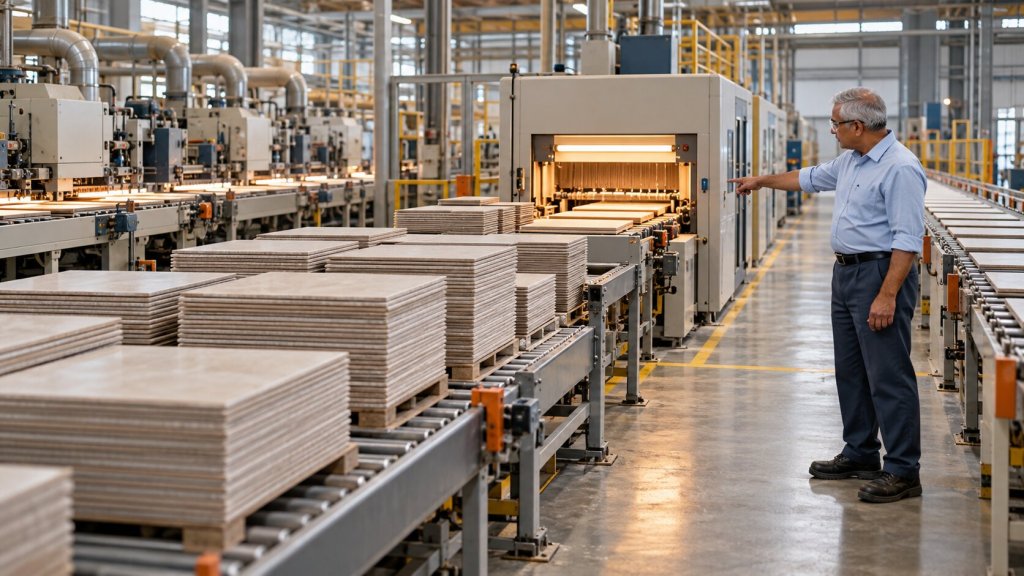
A lesson that has stayed with me from manufacturing is that a busy shop floor is not necessarily a productive shop floor.
Machines may be running. People may be occupied. Materials may be moving. Production reports may show high utilization.
Yet customer orders can still be late, inventory can continue to rise, and teams can spend much of their time expediting work.
The problem is often not insufficient activity.
It is activity that is not synchronized with the flow of the entire operation.
The Attraction of High Utilization
A machine represents a significant investment. When it is standing idle, the natural reaction is to put it to work.
This can appear financially responsible:
- The equipment is available.
- Operators are present.
- Materials are ready.
- Producing more seems better than waiting.
For an individual work center, that reasoning can make sense.
But a factory does not deliver through one machine. It delivers through a connected sequence of operations.
If an upstream operation produces faster than the next operation can process, the additional output does not immediately become customer value. It becomes work-in-process inventory.
The machine appears productive.
The system may not be.
The Constraint Sets the Pace
Every manufacturing flow has a limiting point at a particular time.
It might be equipment capacity, changeover time, maintenance availability, material supply, inspection capacity, skilled labor, packaging, or another operational dependency.
That constraint determines how much the complete system can deliver.
Producing more at a non-constrained operation does not automatically increase finished output. It may simply create a larger queue before the constraint.
The result can be:
- More work-in-process
- Longer manufacturing lead times
- Additional material handling
- Greater scheduling instability
- More space used for waiting inventory
- Quality problems discovered later
- More effort spent identifying priorities
The individual machine may report excellent utilization while the factory becomes slower and more difficult to manage.
Inventory Can Hide the Real Problem
Excess work-in-process creates a sense of security because material is visibly available for the next operation.
But it can also hide operational weaknesses.
When large quantities wait between process steps, teams may not immediately see where flow is being interrupted. A recurring quality issue can remain unnoticed until many units have already been produced. An equipment problem may be disguised by the inventory accumulated in front of it.
Inventory can keep the process moving temporarily.
It can also delay the signal that the process needs attention.
A controlled buffer may be necessary. Uncontrolled accumulation is different. It often indicates that production is being driven by local targets rather than by the needs of the complete flow.
The Same Problem Appears in Enterprise Planning
This shop-floor lesson is highly relevant to SAP transformation.
An enterprise system can create production proposals, planned orders, purchase requirements, capacity views, and detailed schedules. But the quality of those outputs depends on the operating assumptions behind them.
The system needs realistic information about:
- Available capacity
- Production rates
- Changeover requirements
- Yield and scrap
- Maintenance constraints
- Material availability
- Queue and processing times
- Dependencies between operations
If these assumptions do not reflect actual operating conditions, the plan may look precise without being executable.
The system can release more work than the factory can absorb. Each department may then focus on completing its own orders and meeting its own utilization target.
The outcome is predictable: more activity, more inventory, more rescheduling, and less confidence in the plan.
This is not necessarily a failure of the planning technology.
It is a failure to connect planning logic with operational reality.
Measure Flow, Not Only Activity
Machine utilization remains useful. It helps identify unused capacity, reliability problems, and potential investment needs.
But it should not be interpreted in isolation.
A balanced operating view should also consider:
- Finished throughput
- Customer-service performance
- Manufacturing lead time
- Work-in-process inventory
- Schedule adherence
- First-pass quality
- Constraint availability
- Frequency of expediting
- Stability of the production plan
These measures reveal whether activity is becoming business output.
A lower utilization figure at one operation may be entirely appropriate if that operation is synchronized with downstream demand. Deliberately waiting can be better than producing inventory that nobody currently needs.
Operational discipline sometimes requires the confidence not to produce.
Business AI Will Optimize the Objective We Give It
Business AI can help identify emerging constraints, predict delays, recommend schedule changes, and evaluate alternatives.
But AI does not eliminate the need to define the right objective.
If an AI-supported planning process is instructed to maximize equipment utilization, it may recommend actions that keep machines busy while increasing inventory and extending lead times.
If the objective reflects end-to-end flow, customer commitments, quality, cost, and operational risk, the recommendations can be more valuable.
Before automating a planning decision, leaders should therefore ask:
What behavior will this measure or algorithm encourage?
A sophisticated optimization model aimed at the wrong objective can produce the wrong result more efficiently.
The Leadership Question
Local performance measures are attractive because they are easy to assign and monitor.
Production manages utilization. Maintenance manages downtime. Quality manages defects. Supply chain manages inventory and service.
But the customer experiences the combined result.
Leadership must therefore look beyond whether every function met its individual target and ask whether the end-to-end operation delivered what the business needed.
The goal is not to keep every resource continuously active.
The goal is to make the entire system productive.
A machine can be busy without creating additional value.
A factory creates value when material flows through the complete process safely, predictably, with the required quality, and in response to real demand.
The best-performing operation is not always the one with the most activity. It is the one that converts activity into dependable flow.

