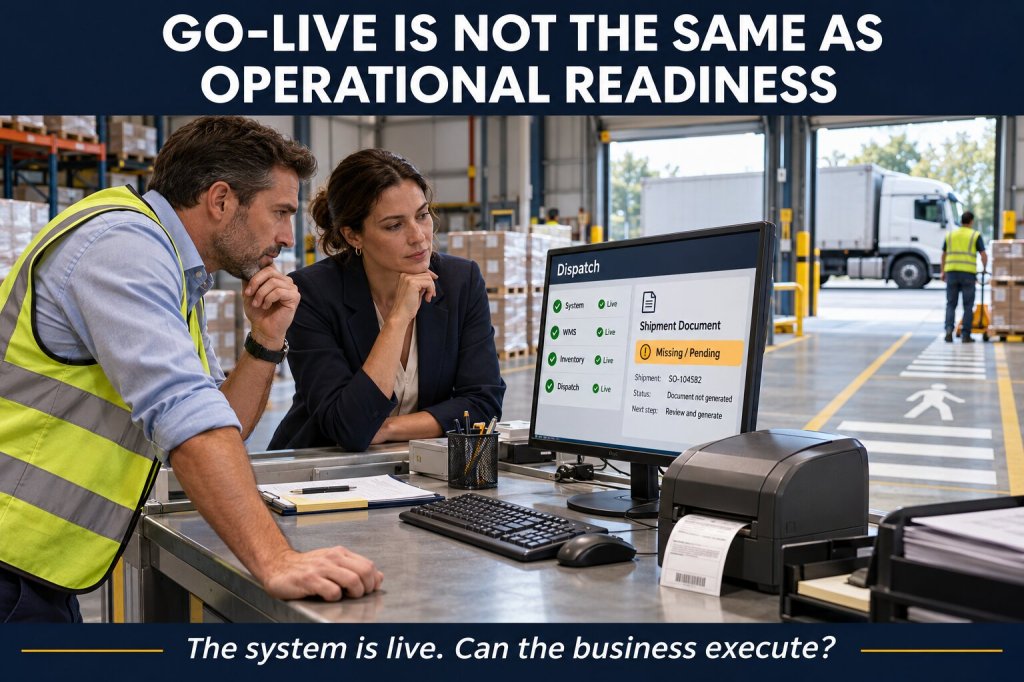
On the first morning of go-live for a large enterprise transformation, senior leaders gathered at the warehouse. What they wanted to see was straightforward: trucks leaving with customer deliveries.
The central system was live, and transactions could be processed. But several operational issues surfaced. One involved a delivery document required for dispatch. The document had been developed in one technology environment and did not work correctly in the environment used at the warehouse.
It was one of several issues that morning, but it made the distinction clear. The system could process a delivery. The warehouse could not dispatch it as planned.
Test all the way to the loading dock
A successful transaction tells us that a step worked. It does not tell us that the people responsible for the next step can do their work.
For a warehouse, that means testing more than whether an order can be created or a delivery processed. Can the dispatch team produce and use the required document at its own workstation? Can it handle an exception without losing track of the shipment? Can the truck leave with everything it needs?
Those questions change how we test an SAP transformation. Instead of ending a test when the transaction succeeds, we follow the work through to the intended business outcome. We use the equipment and operating environment the team will actually rely on. And we ask the people who will run the process to show us where it can break.
Knowledge transfer is not ownership transfer
The first morning tests whether the business can operate. The weeks that follow test whether it can keep operating as the project team steps back.
During implementation, a project leader can bring warehouse operations, IT, and the implementation partner together to resolve an issue quickly. After go-live, that coordination has to work without the project structure. A support team may know how to restore document output, but someone in the business still has to decide how to handle affected shipments, communicate delays, and make sure the same problem does not recur.
That is the difference between handing over instructions and handing over ownership. Instructions explain how the process works. Ownership establishes who makes the call when it doesn’t.
Managed services can diagnose incidents and help restore service. The business still owns the customer commitment and the operating decision.
Two questions before go-live
Before signing off, I would ask leaders to walk through one critical process with the people who will run it and answer two questions:
- Can the team complete the work end to end in the environment it will use on Day One?
- If a step fails, who can make the business decision and coordinate recovery once the project team steps back?
If either answer depends on someone from the project being in the room, there is still work to do.
Go-live is an important milestone. But at the warehouse, the clearest measure was never the status on a screen. It was whether the truck could leave—and whether the team could get the next one out without the project team standing beside them.

